Step, Skip, and Balloon Payments on Equipment Leases (A Broker-Friendly Guide)
Most equipment lease quotes start life as a level payment: same amount every month until the end. Then the client says something like: "Can we ramp up after year one?" or "We skip December every year" or "We need a big final payment because of our cash cycle."
Those three ideas are the heart of step, skip, and balloon (and close cousins like interest-only windows). You do not need a finance PhD to explain them. You do need consistent language so everyone in the room means the same thing when they nod.
Step payments: the payment amount changes on a schedule
Step usually means the payment amount changes at known dates while the rest of the deal shape stays the same idea (term, frequency, residual or buyout story, and so on).
Classic example: a seasonal business wants lower payments in the slow months and higher payments when cash is strong. Another: a startup wants a staircase that climbs as they expect revenue to ramp.
What to watch with the client:
- Cash flow is the headline story for them.
- Yield and rate still have to hang together for you and the funder. A stepped schedule is not "the same deal with different window dressing." It is a different cash flow pattern, and the effective cost to the lessee can move in ways that are not obvious from the first step alone.
When you document a step structure, write down dates or periods where the payment changes and the exact payment (or the rule that produces it). Ambiguity here is how deals come back to bite everyone after funding.
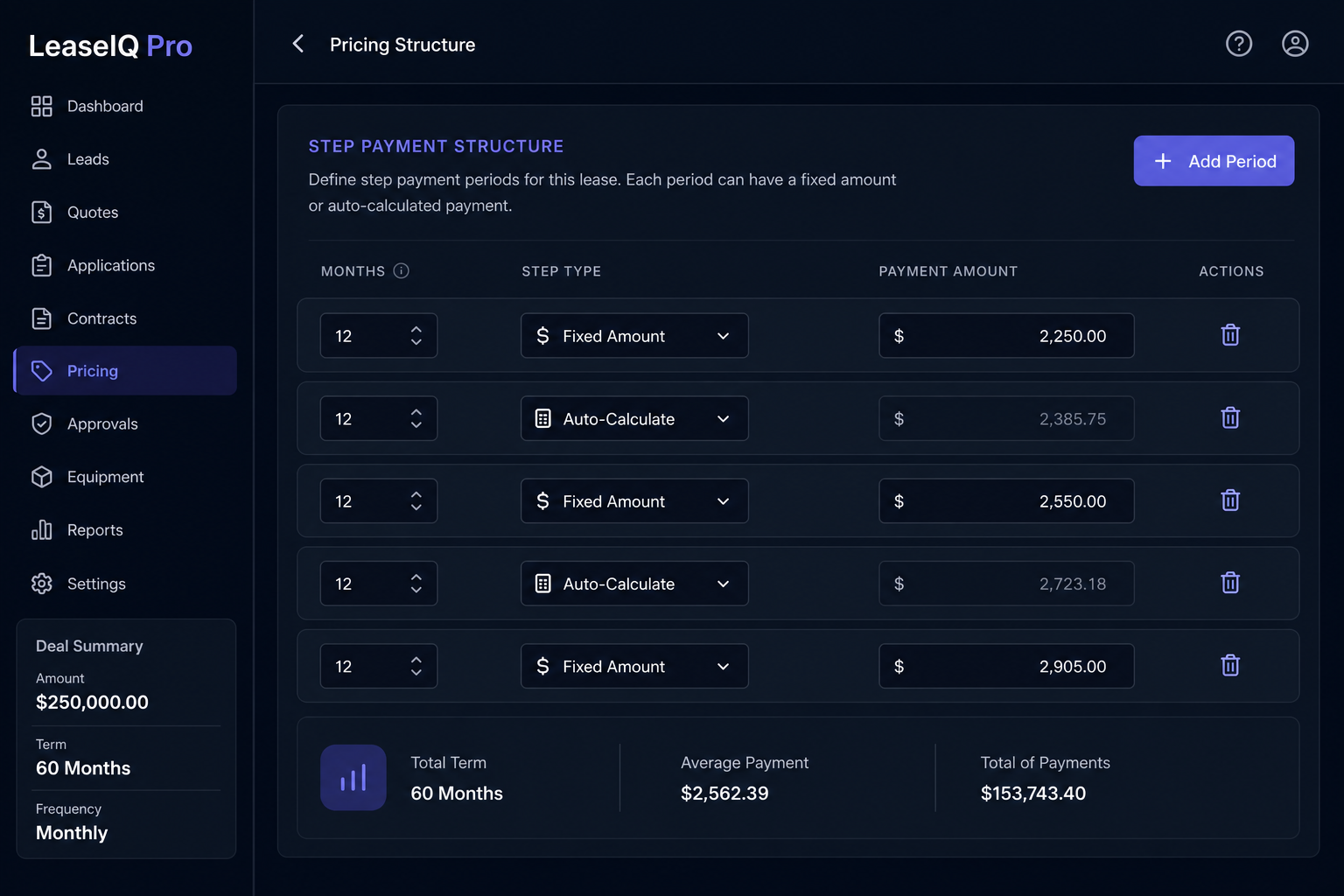
In LeaseIQ Pro, you build steps in a dedicated step payment structure panel: add periods, set how many months each rung lasts, and choose whether each rung is a fixed dollar amount, a percent change over the previous rung, compounding growth, or an auto-calculated payment that solves to your target rate. The goal is to keep the ladder explicit while the engine keeps yield and schedule math aligned.
Skip payments: specific periods with no payment (or interest-only)
Skip usually means certain periods have no scheduled payment, or sometimes interest only, depending on how your shop defines the word and how the contract reads.
Common patterns:
- Annual skip: no payment in a chosen month each year (December is a frequent pick for businesses that close books or have seasonal dips).
- Multiple skips tied to industry rhythm (for example, aligned with a fiscal calendar).
What to watch:
- Skips change average outstanding balance and timing of principal reduction compared with level pay. That affects yield and sometimes credit presentation if the funder models the exposure differently.
- Make sure the client understands what happens in the skip month in plain language: "No check that month" is not the same as "free money that month" from a cost-of-funds perspective.
If you are comparing a skip structure to a level alternative, line up total cash out, number of payments, and residual or end-of-term obligation so the comparison is honest, not just "lower payments now."
Skip months in LeaseIQ Pro (calendar plus seasonal patterns)
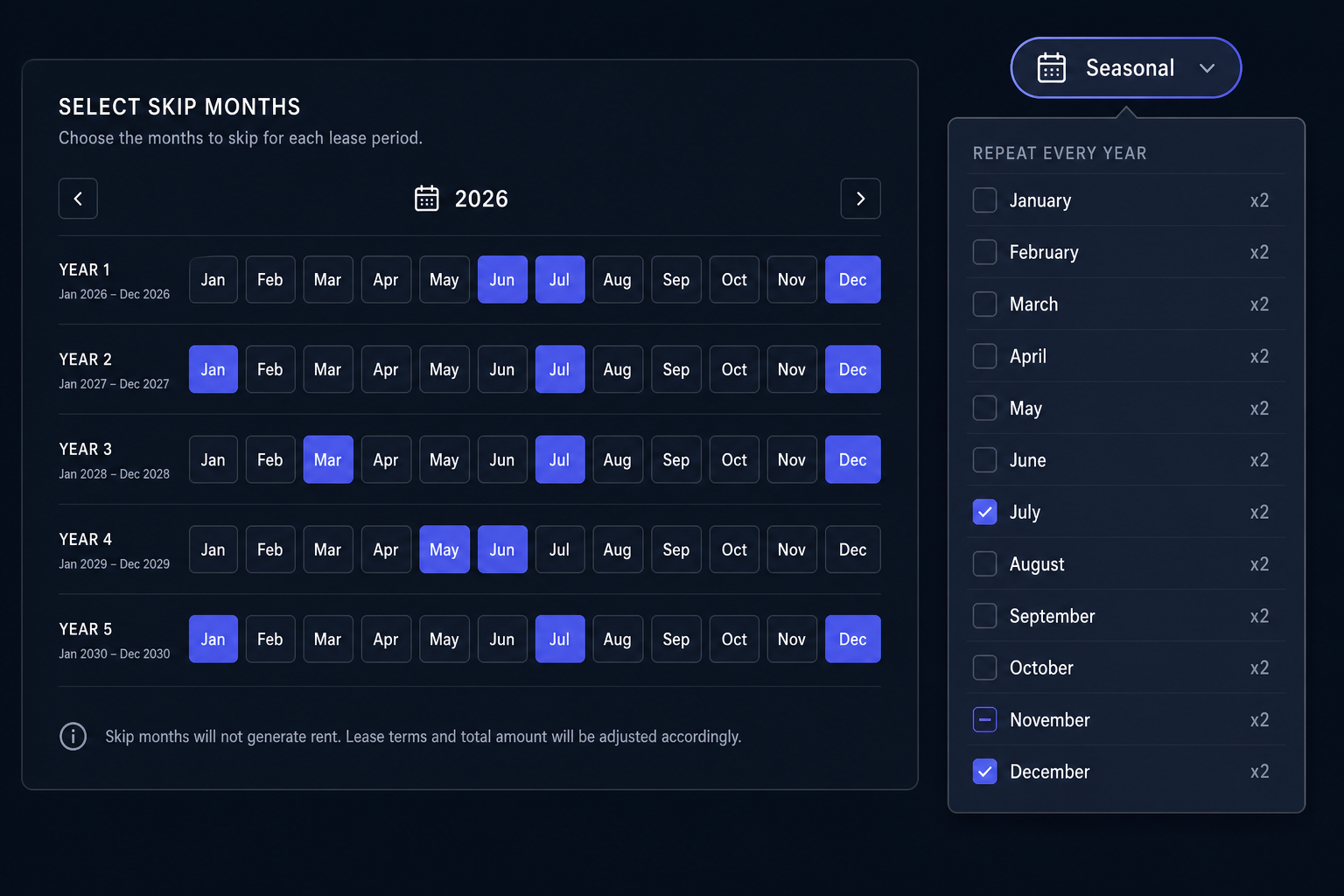
Skip logic is easy to describe in a meeting and surprisingly annoying to type into a generic spreadsheet row by row. In LeaseIQ Pro, when you choose a skip payment structure, you get a skip month calendar that is tied to your lease start date and term:
- The schedule is laid out as real calendar months across the lease (labels like Jan, Feb, Mar), grouped by year, so you see the rhythm the way the client thinks about it, not only "period 17."
- Tap any cell to toggle that period in or out of the skip set. Selected skips use a clear highlight so the pattern is obvious at a glance.
- The Seasonal control (calendar icon) opens a Repeat every year list. Pick December, January, or any month that actually appears in this term, and the app selects every matching calendar month across all the years in the lease in one action (for example, every December in a 60-month deal). Click again to clear that pattern for that month. Months that never occur in the term do not clutter the list.
- You get a live count of how many periods are skipped, plus Clear all when you want to reset and try another pattern.
- You can still set skip payment amount (including interest-only behavior for skipped periods where that applies to your structure) next to the calendar so the economics stay tied to the visual.
The image below is an illustrative composite (the live product stacks the dropdown under the header; here the grid and the seasonal list are shown side by side so you can see both ideas in one glance).
Balloon payments: a large scheduled payment (often at the end)
Balloon usually means a large payment scheduled at an agreed point. Often that is near the end of the term, but some structures put a balloon earlier and then re-amortize or refinance the remainder, depending on the product and what the parties want.
Balloons show up when:
- The lessee wants low regular payments and can handle a lump later.
- The deal is structured with a renewal or purchase decision at a milestone, and the balloon lines up with that decision.
What to watch:
- Balloons concentrate refinance risk or refinancing friction at a single date. Credit and the client both care.
- If the balloon is at the end, the client should understand what options they have at that point (purchase, renew, return, refinance) in the same language your proposal uses.
Quick comparison (how to describe them in one sentence each)
| Structure | One-sentence pitch to a client |
|---|---|
| Level | Same payment each period; easiest to explain and model. |
| Step | Payments change on a published schedule (up or down) to match cash flow. |
| Skip | Certain periods have no payment (or interest-only), on purpose, on a fixed calendar. |
| Balloon | A large agreed payment, often late in the term, with the rest of the schedule built around it. |
Why spreadsheets get painful here
Level pay is spreadsheet-friendly. Step, skip, and balloon schedules are still doable in a grid, but the iteration starts to matter: when you change one rung on the ladder, you often have to rebuild the whole waterfall to keep rate, yield, and payment aligned with how your funder or credit team models the deal.
That is the moment when originators start saying: "I am not rebuilding this model from scratch in the parking lot."
A purpose-built lease structuring tool is not magic. It is a way to keep one source of truth for the schedule while you try variants in front of the client.
Compliance and clarity (without playing lawyer)
This article is about language and workflow, not filing advice. How you describe step, skip, and balloon on a client-facing proposal should match your shop's standards and any Reg Z or disclosure obligations that apply to your product and jurisdiction. When in doubt, use the same wording your compliance team already approved for similar structures.
Putting it together on the next live call
When a client throws a curveball:
- Name the pattern: step, skip, balloon, or a blend.
- Write the rules (dates, amounts, what happens in skipped periods).
- Compare at least one level-pay alternative with the same economic story so the tradeoffs are visible.
- Save the version you actually showed them so the story does not drift between the meeting and funding.
If you want to run those variants in a tool built for commercial lease originators (including step, skip, balloon, and blended-rate shapes), you can start a free trial of LeaseIQ Pro and stress-test the next deal on whatever device you carry into the meeting.
Seven-day trial. Structure from your phone, white-label proposals, offline-first math when you need it.
Start free trial